
A succesful real estate sale process is rarely only about timing, pricing, and market appetite. It is also about preparation.
Before a property is brought to market, owners typically spend time preparing financial information, lease material, legal documentation and commercial assumptions. Technical preparation should be treated with the same level of attention.
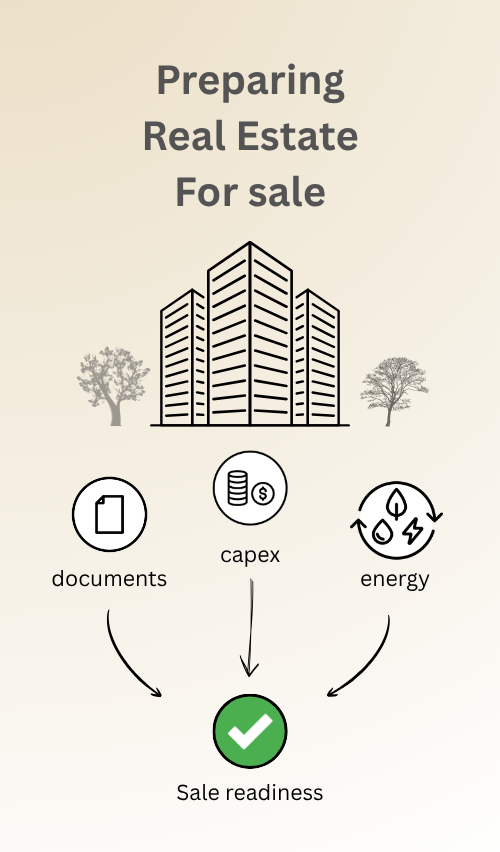
The technical condition of a property, the quality of available documentation, the clarity of future capital expenditure and potential for energy improvement can all affect how buyers assess risk. If these matters are not understood before the sale process begings, they may emerge later during the buyer due diligence, often at the least convenient time of the transaction.
Preparing real estate for sale does not mean making the asset appear risk-free. It means understanding the technical position early, structuring the information clearly and reducing avoidable uncertainty.
Buyers don’t only price defects, they price uncertainty
In a transaction, technical defects are only part of the risk picture.
Buyers also react to uncertainty. Missing documentation, unclear maintenance history, unresolved technical issues or vague capex assumptions can all affect buyers confidence.
If the technical position is unclear, buyers prefer to take a conservative view. This can lead to:
- Broader capex assumptions
- Additional questions during due diligence
- Extended review periods
- Price adjustment discussions
- Increased warranty and indemnity focus, or
- Reduced confidence in the asset
In many cases, the issue is not that the property has technical defects. Most real estate assets do. The issue is that the seller doesn’t have a clear, structured explanation of what the findings mean, what has already been managed and what should be considered normal lifecycle costs.
This is where controlling the technical narrative becomes important. If the seller has not prepared the technical position in advance, the buyer’s advisors may become the first party to frame the asset’s condition, capex needs and risk profile in a structured way.
Technical preparation before the sale process helps avoid that, allowing the seller to understand the likely technical questions before the buyer’s advisors raise them, and to present the asset with clarity rather than react to findings later in the process.
Vendor-side technical review helps the seller understand the asset first
A vendor-side technical review gives the seller an early view of the asset from the perspective of a future buyer.
The purpose is not necessarily to produce a full buyer-style technical due diligence in every case. The scope can be adjusted depending on the asset, transaction strategy and available timeline.
However, a focused pre-sale review can help identify:
- Visible technical defects
- Near-term capex costs
- Deferred maintenance
- Documentation gaps
- Statutory inspection gaps
- Energy performance questions
- Environmental or property history concerns
- Tenant alteration or responsibility issues, and
- Matters that may require clarification before marketing
This gives the seller time to decide what to repair, what to document, what to explain and what to disclose.
That distinction matters. Not every issue needs to be solved before a sale, but material technical issues should be understood before they becine buyer-led negotiation points.
Disclose, don’t surprise
In real estate transactions, technical findings are not automatically problematic. Surprises are.
A known issue with a clear explanation is usually easier to manage than a late-stage finding discovered by the buyer. If the seller can show that a matter is understood, priced, planned or already covered by existing maintenance actions, the discussion becomes more balanced.
Timing matters. A disclosed technical issue can be considered by bidders before offers are submitted, allowing it to be reflected in pricing in a controlled and comparable way. A surprise discovered later in the process is different. At that point, it often shifts leverage towards the buyer, as the issue is assessed more defensively and may become part of late-stage price negotiations, risk allocation and warranty issues.
For example, an ageing roof may not need to be replaced before sale, but the seller should ideally understand its condition, likely remaining service life, repair history and expected future cost. Without that information, the buyer is likely to assume the worst.
The same applies to building services, facades, fire safety systems, drainage, energy performance and other technical areas. If the seller does not control the technical narrative, the buyer’s advisors may define it.
Good preparation does not limit the buyer’s right to assess the asset independently, but it can reduce the risk that ordinary lifecycle issues are treated as unexpected problems.
Technical data room matters
The quality of the technical data room can have a significant effect on the due diligence process.
A strong data room helps buyers and their advisors understand the asset more efficiently, while a weak dataroom creates questions, delays and uncertainty.
Relevant technical information may include:
- Drawings and area information
- Building permits, authority documentation
- Maintenance records
- Service contracts
- Statutory inspection records
- Condition reports
- System specifications
- Fire safety documentation
- Environmental reports
- EPCs
- Energy consumption data, efficiency assessments
- Completed repairs
- Capex plans
- Tenant alteration documents
- Warranties and contractor documentation
The point is not to provide unnecessary volume, but to provide relevant, organized and usable information.
A large quantity of poorly structured documents can still leave the buyer uncertain. In contrast, a clear technical data room can make the process faster and more controlled.
Capex assumptions should be realistic and defensible
Capital expenditure is often one of the most important technical topics in a sale process. After all, it can define whether the investment case works or not, particularly when those costs are reflected in the buyer’s financial model.
If a seller does not have a clear view of future capex, the buyer is sure to create one. The buyer-side estimate may be conservative, particularly if documentation is incomplete or the technical condition is unclear.
Vendor-side preparation can help establish a more balanced view of capital requirements.
A useful capex schedule should distinguish between:
- Urgent repairs
- Lifecycle replacements
- Deferred maintenance
- Statutory or compliance-related items
- Tenant-related works
- Energy improvement measures
- Optional upgrades
- Longer-term asset management actions
The timing of capex is also important. A cost expected immediately after acquisition is likely treated differently from costs occuring later in the holding period.
A realistic and defensible capex view helps the seller avoid a situation where every technical issue is treated as a near-term deduction in value.
Energy efficiency is becoming a part of transaction readiness
Energy performance is increasingly relevant in real estate transactions. Buyers may consider not only the current energy certificate or consumption levels, but also the potential for improvement, the cost of identified measures and the likely effect on future operating performance.
This is particularly important where investors have defined sustainability targets or asset improvement roadmaps. For these buyers, the question is not only whether the asset performs adequately today, but whether it can be improved over time in a technically and commercially realistic ways.
In some cases, lack of visibility can affect bidder participation. If investors cannot understand the asset’s improvement potential, likely capex requirements or pathway towards their own sustainability targets, they may discount the asset heavily, or choose not to bid at all.
For sellers, this means that energy efficiency should not be treated only as a compliance topic. It can also affect the buyer confidence, capex assumptions and the perceived future readiness of the asset.
A pre-sale energy efficiency analysis can help clarify:
- Current energy performance
- Improvement potential
- Realistic capex requirements
- Expected impact of selected measures
- Potential effect on EPC
- Operational constraints
This does not mean that the improvements should be completed before sale. In many cases, the value is in understanding the options and presenting them clearly. If energy improvement measured are already identified, assessed and linked to realistic cost assumptions, the seller is better positioned to discuss future performance with buyers.
Used properly, energy efficiency analysis can support a more credible technical narrative around the assets, especially where energy costs, ESG expectationgs, sustainability roadmaps or future regulatory requirements are likely to influence the buyer.
Sale preparation supports better control
When the seller understands the technical position before going to market, the sale process becomes easier to manage.
The seller can then decide:
- which issues to address before marketing
- which issues to disclose and explain
- which documentation gaps should be closed
- which capex assumptions should be prepared for
- which buyer questions are likely to arise
- which matters may need legal or commercial consideration
This creates a more controlled process. Instead of reacting to technical findings during buyer due diligence, the seller can prepare the explanation in advance.
This is particularly valuable in competitive processes, portfolio transactions and assets where technical complexity may affect buyer confidence.
Technical preparation is not only for distressed or problematic assets
Pre-sale technical preparation is sometimes associated with assets that have obvious problems. That is short-sighted.
Even technically sound properties benefit from preparation.
For high-quality assets, the goal may be to demonstrate that the property is well maintained, properly documented and supported by a clear capex outlook. This can strengthen buyer confidence and reduce unnecessary due diligence friction.
For older and more complex assets, the goal may be to separate normal lifecycle matters from more material risks. This helps prevent the buyer from treating all technical issues equally.
In both cases, the principle is the same: the seller should understand the technical story before the buyer writes it.
Preparing for sale during ownership
The best time to prepare an asset for sale is not always when the sale process starts.
Technical readiness is built during ownership. Maintenance records, statutory inspections, repair documentation, capex planning and energy performance information are all easier to manage when they are kept up to date over time.
A pre-sale technical review can be especially valuable when:
- A sale is planned within the next 6-24 months
- The asset is older or technically complex
- The property has known deferred maintenance
- Documentation is fragmented
- Major capex items are expected
- Tenant modifications have been carried out
- Enegry performance is a likely buyer concern, or
- the owner wants to reduce late-stage negotiation risk
In this sense, technical preparation is not only a transaction exercise, it’s part of good asset ownership.
From technical information to transaction readiness
Preparing real estate for sale is not about hiding problems or presenting an unrealistic picture of the asset. It’s about clarity.
A well-prepared seller understands the technical condition of the property, the quality of the documentation, the likely capital expenditure and the issues that may matter to the buyers. This doesn’t eliminate buyer due diligence, but it can make the process more efficient and reduce avoidable uncertainty.
At Evenfall Advisory, we support real estate owners and transaction teams with sell-side preparation, vendor due diligence, energy efficiency analysis and transaction-phase technical advisory. Our focus is on helping sellers understand the technical position early, structure information clearly and prepare for a more controlled transaction process.